
Engineering Leadership Within an Established Group: The TC Engineering Proposition

When a facility owner in Malta commissions a complex industrial or commercial project, the choice of engineering partner is one of the earliest and most consequential decisions they will make. The right partner shapes whether the project is delivered on time, within budget, and to the regulatory standard the facility demands. The wrong one introduces risk that compounds at every stage.
Yet the options available in Malta have traditionally forced an uncomfortable trade-off. On one side, smaller local consultancies offer proximity and responsiveness but may lack the multidisciplinary depth and international compliance experience needed for complex regulated facilities. On the other, large international firms bring technical capability but often lack the local networks, permitting knowledge, and on-the-ground accountability that Maltese projects require.
Neither model fully serves the needs of a project owner building a pharmaceutical plant, a healthcare facility, a food production line, or any other high-performance environment where regulatory compliance, technical coordination, and commercial control must all work together.
So what should you look for? Based on our experience delivering complex facilities across Europe, here are the criteria that matter most.
Technical Depth Across Multiple Disciplines

Industrial and commercial facilities are multidisciplinary by nature. A pharmaceutical cleanroom involves process engineering, HVAC design, electrical systems, automation, civil and structural work, and qualification protocols, all of which must be coordinated. When these disciplines are split across separate consultancies, the project owner inherits the coordination burden, and with it, the risk of design clashes, misaligned assumptions, and qualification gaps.
Look for a partner with genuine in-house multidisciplinary capability, meaning they can deliver civil, structural, mechanical, electrical, process, and automation engineering from a single coordinated team. This is not just a convenience. It is what prevents the knowledge gaps between disciplines that cause the most expensive problems on-site.
At TC Engineering, this multidisciplinary model is how we operate by default. Our engineering team covers every discipline required for a complex facility, coordinated through a single project structure with one point of accountability.
Proven Experience in Regulated Environments

Malta’s growing life sciences and advanced manufacturing sectors mean that an increasing number of projects must satisfy demanding regulatory frameworks: EU GMP for pharmaceuticals, HACCP for food production, ISO 14644 for cleanrooms, and various EU directives for healthcare facilities. These are not standards that can be learned on the job. They require engineering teams with deep, demonstrable experience in designing and qualifying facilities to these benchmarks.
When evaluating an engineering partner, ask for evidence of completed projects in regulated sectors, specifically the scale, the regulatory framework applied, and whether the same team handled both design and qualification. A partner who can design a facility but relies on a third party for commissioning and qualification introduces exactly the kind of handoff risk that leads to compliance failures.
TC Engineering’s strategic alliance with the Techniconsult Group provides this depth. Founded in Florence in 1987, Techniconsult has nearly 40 years of experience delivering integrated engineering for the life sciences and pharmaceutical sectors across Europe. Their portfolio includes the complete design of a €235 million pharmaceutical manufacturing facility spanning 26,000 square metres, and a €110 million biotech facility delivered under the LEED protocol to achieve Gold certification. This is the technical heritage that supports every TC Engineering project in Malta.
Local Accountability and Networks
International expertise means little if it cannot be delivered locally with speed and accountability. Maltese projects operate within a specific context: local permitting authorities, a concentrated supply chain, site logistics shaped by the island’s geography, and a business culture built on relationships and trust. An engineering partner needs to navigate these realities fluently, not as a remote consultant issuing instructions from abroad.
This is where TC Engineering’s local structure matters. We are an independent Maltese entity, registered and operating in Malta, with a local team delivering directly to Maltese clients. The strategic investment from Mark Bajada, founder and chairman of Bajada Lyons Group, one of Malta’s most established diversified investment groups with interests spanning renewable energy, healthcare, engineering, and hospitality, strengthens this local foundation further. It provides TC Engineering with direct access to deep-rooted commercial networks, supply chain relationships, and operational insight that would take a new entrant years to build.
Digital Tools That Reduce Risk, Not Just Presentation Aids
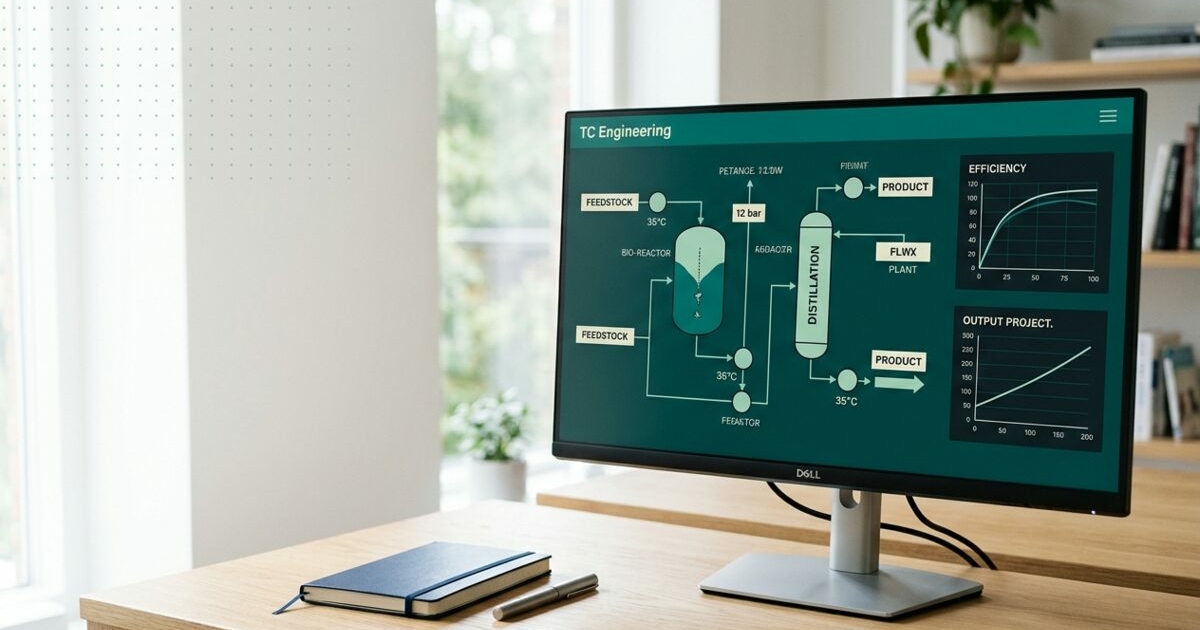
Many firms reference digital tools in their marketing. The question is whether those tools are integrated into the engineering workflow or used primarily for client-facing presentations. Tools like CFD, process simulation, and BIM only reduce project risk when they are used by the same engineers making design decisions, embedded in a coordinated model, and applied from the earliest project stages.
At TC Engineering, our in-house digital capabilities, including process simulation, CFD modelling, BIM with 3D laser scanning, and a Common Data Environment, are not add-on services. They are part of the engineering process from concept through to handover. For a more detailed look at how we apply these tools to prevent design clashes and optimise facility performance, see our article on digital engineering and clash prevention. [Cross-link to Article 2: /insights/design-clash-prevention-integrated-engineering-malta]
Full Lifecycle Coverage, from Design to Qualification
The most common source of project failure in regulated facilities is the gap between design completion and operational qualification. When a separate validation consultant arrives at the end of the process to assess a facility they had no involvement in designing, compliance gaps are almost inevitable. The qualification requirements should shape the engineering design from day one, not be applied as a retrospective checklist.
This is a core principle of integrated engineering, and it is the model TC Engineering follows. Our services cover the full project lifecycle: consultancy and engineering, construction oversight, commissioning and qualification, and containment and monitoring. The same team that designs the facility is the team that qualifies it, ensuring continuity of knowledge, documentation, and regulatory intent throughout.
For a broader perspective on why integrated lifecycle delivery matters for Malta’s industrial future, see our article on the case for integrated engineering. [Cross-link to Article 1: /insights/integrated-engineering-malta-future]
Frequently Asked Questions
What should I look for in an engineering consultancy in Malta?
Prioritise multidisciplinary capability (not just one specialism), demonstrated experience in your regulatory environment, genuine local presence with on-the-ground accountability, integrated digital tools embedded in the engineering workflow, and full lifecycle coverage from design through to commissioning and qualification.
What is the advantage of an integrated engineering partner over separate consultants?
When multiple separate consultants handle different disciplines, the project owner inherits the coordination risk. Misalignments between structural, mechanical, electrical, and process engineering are discovered late, causing rework and delay. An integrated partner manages all disciplines under one team, eliminating handoff gaps and ensuring design decisions are coordinated from the outset.
How does TC Engineering combine international experience with local delivery?
TC Engineering is an independent Maltese company that operates through a strategic alliance with the Italy-based Techniconsult Group, which has nearly 40 years of experience in regulated facility design across Europe. A strategic investment from Bajada Lyons Group, one of Malta’s most established investment groups, provides deep local commercial networks and operational insight. This structure gives clients access to international technical depth delivered by a locally accountable team.
Can TC Engineering handle both design and qualification?
Yes. Our services cover the full project lifecycle, including consultancy and engineering, construction coordination, commissioning and qualification, and containment and monitoring. This integrated approach ensures that qualification requirements inform the engineering design from day one, rather than being applied retrospectively.
■ Planning a complex project in Malta?
Talk to our team about how integrated engineering, international expertise, and local delivery come together.
